
Design for the
agentic era
Crafted for humans, and for the AI tools they create with every day.
the problem
When anyone can create anything, brand is what's left
AI made creation effortless. Every team can now produce their own work without waiting for design. But AI is an amplifier, not a mind reader - give it a strong foundation and it creates remarkable things; give it scattered files and no context, and it amplifies the mess, confidently and at scale.
The damage shows up where it matters most: at every touchpoint with your customers. Products fragment, decks turn generic, marketing drifts. Different symptoms, one condition - a brand showing up off-brand, everywhere, faster than ever.
Speed is easy now, recognition isn't.
But it can be, by design.
what i do
Your Head of Design,
from outside
Your brand lives at every touchpoint - product, marketing, events, sales. Most companies treat those as separate jobs for separate hands. I treat them as one job: making sure everything you put in front of people is unmistakably you.
Start with a review
I look at what you have - design system, brand assets, how your teams create today - and give you a clear picture: what's strong, what's missing, what to build first.
Design, end to end
Product interfaces, design systems, websites, marketing materials, event experiences, pitch decks. Much of it I craft myself; where a piece needs a specialist, I bring in the right people and direct the work. One coherent result - my responsibility.
AI-ready, by default
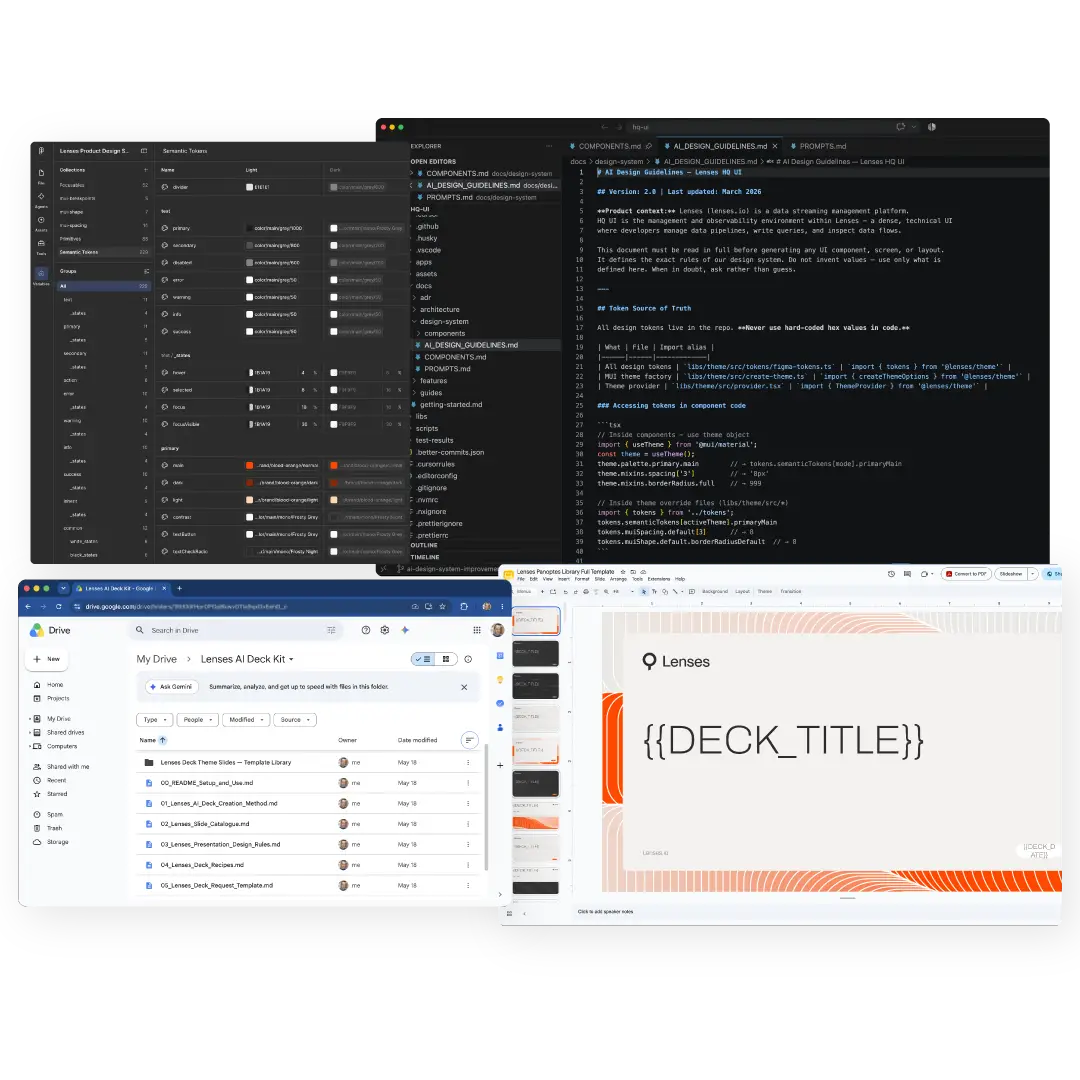
Everything I deliver is built for how teams work now: design systems your engineers' AI tools can read, deck templates AI can generate from, assets organised so your tools produce on-brand work. Already have these? I'll make them AI-ready.
Need this ongoing? I work as a fractional Head of Design on retainer.
The Process
How we'd work
together
Every project starts the same simple way - you tell me what you need - and grows from there into a process built around your project, not a rigid template.
Inquiry
A short brief, or just a question - what you need, and whether I can help. No formal process required to start the conversation.
Onboarding
You bring me up to speed - not just guidelines and past work, but the business itself: your product, your clients, who you're actually talking to.
Independence
By the end of it, I'm not guessing. I understand your brand and the thinking behind it well enough to work on my own and pick up new tasks without being walked through everything again.
The plan
I turn what I've learned into a creative brief, then we agree on timeline, deadlines, and how we'll communicate. Once this is set, repeat projects move faster - the groundwork is already done.
A few directions, then one
I usually present three or four initial concepts. We choose a direction together, I develop it further, and we go through a couple of rounds of feedback until it's right.
Whatever the team needs
What you get depends on who's asking - print and digital files for a campaign, tokens and exports for your engineers, a ready-to-use deck for sales.
Direct to the team
I can work with whichever team needs it - sales, engineering, marketing - directly, if that fits how you operate. I adapt to your workflow, not the other way around: agile or not, two-week sprints or a different rhythm, wherever you track and report work, that's where I show up.
Work together on a few projects, and it often becomes something more ongoing - I plug into your team directly, no go-between required. At that point I'm not really outside anymore. I'm a team member.
SELECTED WORK
One brand,
every touchpoint
Six years with one company, growing from brand and marketing work into leading design across product, brand, marketing, and events. That's the point: one person, holding it all together.
Assets
Brand guidelines are only as good as what you do with them. I take the colors, type, and concept behind a brand and turn them into the assets teams actually use - social posts, email campaigns, LinkedIn banners and carousels - keeping every piece recognisably on brand, channel after channel, month after month.
Website
A website is where a brand has to hold together under the most scrutiny - every page, every state, every device. I design and build sites that carry a brand properly: the design system behind the pages, new modules and behaviors as the product grows, navigation that actually works on mobile. Not just how it launches - how it holds up a year in.
Events
An event is a brand compressed into one physical space - booth, signage, merchandise, the t-shirt someone still wears a year later. I design the full presence a company brings to an event, from Kafka Summit-scale conferences to smaller industry meetups, so nothing on-site feels like an afterthought.
Product
Most brand guidelines stop at the marketing site - colors and type, nothing about how a product actually behaves. I close that gap: functional palettes, states, the structured, repeatable patterns that let tables, panels, and components stay consistent as a product grows and changes.
Decks
A good deck template outlives any single presentation. I build full systems - light and dark mode, title and agenda slides, layouts for graphs and illustrations - so a team can put together a deck that looks considered, not cobbled together, every single time.
Assets
Brand guidelines are only as good as what you do with them. I take the colors, type, and concept behind a brand and turn them into the assets teams actually use - social posts, email campaigns, LinkedIn banners and carousels - keeping every piece recognisably on brand, channel after channel, month after month.
Website
A website is where a brand has to hold together under the most scrutiny - every page, every state, every device. I design and build sites that carry a brand properly: the design system behind the pages, new modules and behaviors as the product grows, navigation that actually works on mobile. Not just how it launches - how it holds up a year in.
Events
An event is a brand compressed into one physical space - booth, signage, merchandise, the t-shirt someone still wears a year later. I design the full presence a company brings to an event, from Kafka Summit-scale conferences to smaller industry meetups, so nothing on-site feels like an afterthought.
Product
Most brand guidelines stop at the marketing site - colors and type, nothing about how a product actually behaves. I close that gap: functional palettes, states, the structured, repeatable patterns that let tables, panels, and components stay consistent as a product grows and changes.
Decks
A good deck template outlives any single presentation. I build full systems - light and dark mode, title and agenda slides, layouts for graphs and illustrations - so a team can put together a deck that looks considered, not cobbled together, every single time.
Before that: a career built across brand, campaigns, events, and product - for companies across tech and beyond.
The Agentic Era
Adding the AI layer
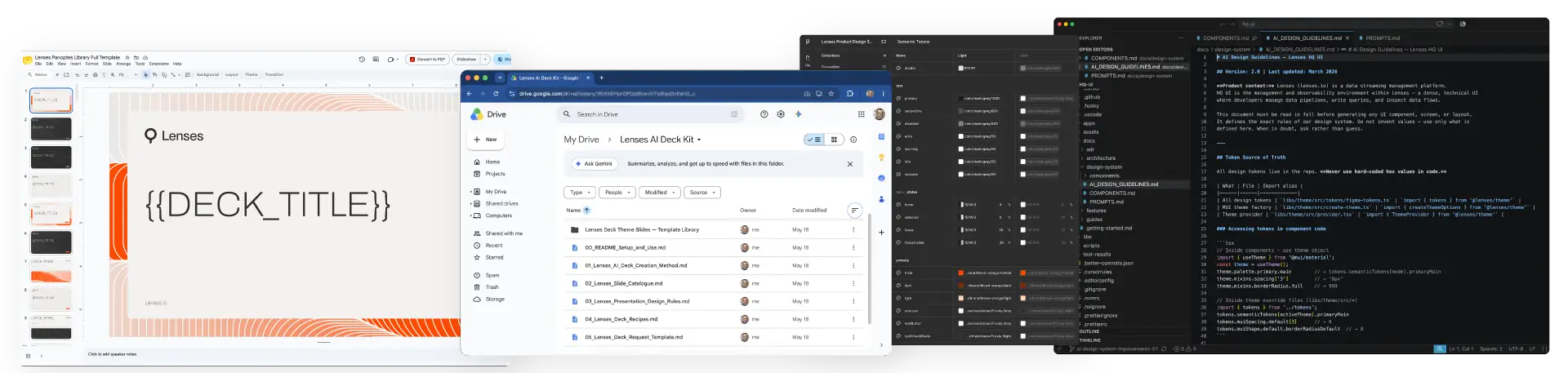
Design systems your engineers' AI tools can build from. Deck templates AI can generate on-brand presentations from. And beyond these two, I keep exploring how AI is reshaping design - from LLMs connected to Figma to tools like Claude Design - because every company's stack is different, and the real challenge is adapting to yours without breaking what makes the brand recognisable.
about
I've worked across advertising, branding, and product design - long before AI was part of the conversation, for brands big and small, in more chaos than I can count. That's taught me "on brand" isn't a slogan, it's a discipline. What I bring to every project is not just good design, but design that holds together under pressure, at speed, across every team that touches it.
Most recently, that discipline met a different kind of test: AI doing more of the creating. The question stopped being "how do we stay on brand" and became "how do we stay on brand when AI is writing half the interface." Figuring that out - and building the AI-ready systems and templates that came out of it - is a core part of what I offer, for companies moving just as fast.
Based in Amsterdam, working with teams from Hong Kong to the US.
about
I've worked across advertising, branding, and product design - long before AI was part of the conversation, for brands big and small, in more chaos than I can count. That's taught me "on brand" isn't a slogan, it's a discipline. What I bring to every project is not just good design, but design that holds together under pressure, at speed, across every team that touches it.
Most recently, that discipline met a different kind of test: AI doing more of the creating. The question stopped being "how do we stay on brand" and became "how do we stay on brand when AI is writing half the interface." Figuring that out - and building the AI-ready systems and templates that came out of it - is a core part of what I offer, for companies moving just as fast.
Based in Amsterdam, working with teams from Hong Kong to the US.
In their words
Milen didn't just bring extraordinary visual design talent - he dove headfirst into product design and UX with the same enthusiasm. He ramped up remarkably quickly on design system best practices, Figma architecture, and tokenisation, and the result was a fully functional design system that genuinely changed the course of the product.
“What makes Milen truly rare isn't just his craft but his approach - he cares deeply about the why behind every decision, the underlying principles, the meaning being conveyed.”
Adamos Loizou
Former Head of Product at Lenses.io
Is your brand keeping up with how fast you're moving?
Let's talk.
I'll write back within 48 hours